

Youth employment amidst cooling labour demand
Prepared by David Chaloupka and António Dias da Silva
Published as part of the ECB Economic Bulletin, Issue 5/2026.
This box analyses the latest trends in the euro area to shed light on the recent deterioration in employment prospects for young workers. Concerns about youth employment have become especially widespread since 2023, following the emergence of generative artificial intelligence (AI). A hypothesis often put forward is that advances in AI are replacing entry-level jobs, limiting job opportunities for young workers. This box explores the extent to which cyclical or more structural factors are at play in the euro area labour market.
The softening of the labour market in the euro area since 2023 has had a more pronounced effect on young workers than on the overall workforce. The ratio of the youth unemployment rate to the total unemployment rate rose to 2.4 in the first quarter of 2026 from 2.1 in the first quarter of 2023, underlining that the labour market situation of young workers has weakened in relative terms. During this period, the unemployment rate in the euro area (workers aged 15 to 74) declined by 0.3 percentage points to 6.3% (Chart A, panel a). By contrast, the youth unemployment rate (15-24 age group) stood at 15.1% in the first quarter of 2026, 0.6 percentage points higher than its 2023 average, suggesting that young workers have not benefited proportionately from the broader labour market improvement seen over the period. This is corroborated by labour force developments. The youth labour force grew by only 0.5% between the first quarter of 2023 and the first quarter of 2026, compared with 2.6% for the labour force as a whole, with the youth participation rate falling by 0.8 percentage points even though the aggregate participation rate rose by a similar margin. Looking at the 25-29 age group, which has a much stronger attachment to the labour market, the respective unemployment rate increased from 8.9% in the first quarter of 2023 to 9.0% in the first quarter of 2026. Similarly, employment growth among young workers has also decelerated significantly – turning negative in recent quarters – following relatively strong growth up until mid-2023 (Chart A, panel b), while employment growth for the 25-29 age group has picked up in recent quarters.
Chart A
Unemployment rate and employment growth by age group
a) Unemployment
(percentages of the labour force)

b) Employment
(year-on-year percentage changes)

Sources: Eurostat and ECB staff calculations.
Note: The latest observations are for the first quarter of 2026. Quarterly seasonally adjusted data.
The less favourable labour market performance of young workers is reflected in their perceptions of their employment prospects. The October 2025 ECB Consumer Expectations Survey (CES) asked respondents whether, compared with the same period one year earlier, it was a good time or a bad time to look for a job. A majority of respondents regarded current job search conditions as no worse than a year previously. However, the assessment of non-employed workers with tertiary education was notably more negative. Among young non-employed workers with tertiary education, the net balance between positive and negative responses stood at -23%, while workers with non-tertiary education tended to express less negative views (Chart B). Highly educated young workers attributed their more negative assessment primarily to a perceived scarcity of suitable job openings. By contrast, young workers with and without tertiary education expressed broadly similar views about general economic conditions and wage offers.
Chart B
Labour market outlook
(net balance, percentage points)
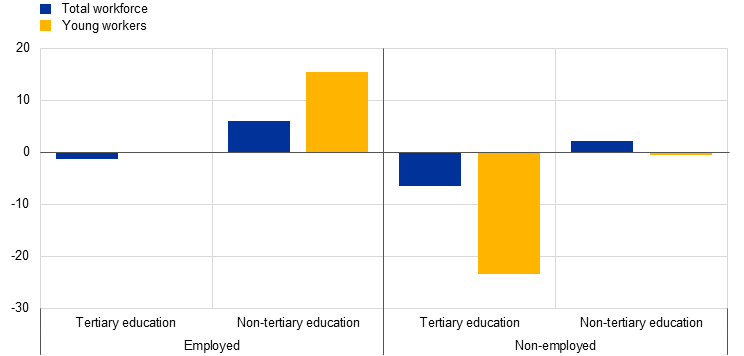
Source: ECB Consumer Expectations Survey and ECB staff calculations.
Note: The chart is based on responses to the question “Compared with the same period last year, is it, in your opinion, a good time or a bad time to look for a job?”, fielded in October 2025.
Young workers generally tend to be more exposed to a deterioration in economic conditions. When economic activity softens, these workers are usually disproportionately affected by a contraction in hiring opportunities. Furthermore, young workers tend to be the first to be dismissed in economic downturns owing to their shorter job tenures and a greater incidence of fixed-term and other precarious employment contracts. The higher cyclical sensitivity of youth employment relative to other groups is well documented (see, for example, ECB, 2021).
To assess whether the employment prospects of young workers are unusually weak, the strength of the broader economy must be taken into account. A dynamic version of Okun’s law relates employment growth among both young workers and all workers to real GDP growth, accounting for lags in both variables. When these variables move in line with historical trends, the residual of the equation is zero. A positive residual indicates strong employment, while a negative residual indicates weakness.
When compared with GDP growth, recent developments in youth employment are broadly in line with normal cyclical dynamics. Total employment was strong in 2022-23 but shows a progressive normalisation towards the end of 2024 (Chart C). For young workers, the residual has shown significantly more amplitude, with strong job creation in 2022-23, followed by slightly negative residuals since late 2024, consistent with a normalisation after a period of robust job creation.
Chart C
Residuals from dynamic Okun’s law estimates
(percentage points)

Sources: Eurostat and ECB staff calculations.
Notes: The latest observations are for the first quarter of 2026. Four-quarter moving average. Knowledge-intensive services (KIS) comprise information and communication technology (ICT), financial services and professional services. Estimates are based on data for the period between the first quarter of 2008 and the first quarter of 2026. The residuals are from a dynamic Okun’s law relationship that relates the quarter-on-quarter growth rate in total employment to the contemporaneous quarter-on-quarter growth rate in real GDP and to one lag each of employment growth and GDP growth.
Employment in knowledge-intensive services (KIS) has moderated following several years of unusually strong growth. The information and communication technology (ICT), financial services and professional services sectors are of particular interest as they are potentially more exposed to the automation of cognitive tasks and have recorded sharp declines in employment in recent quarters. Following two years of strong job creation relative to real GDP growth, the residual turned negative in mid-2024 and has only recovered recently. This is consistent with a correction from the strong post-pandemic employment growth and is reflected in the pessimism expressed by highly educated young workers in the October 2025 CES. Residuals for workers with tertiary education followed a similar pattern, turning negative over four quarters before returning to positive territory from mid-2025.
There is substantial dispersion in employment developments across KIS. Between the first quarter of 2023 and the first quarter of 2026, employment among young workers declined by 18.6% in ICT, 5.3% in professional services and 3.1% in financial services. When analysing these developments against growth in their respective sectors, the residuals from the Okun’s law regression are particularly negative in the ICT segment, suggesting a moderation that extends beyond current cyclical developments (Chart D). By contrast, employment developments in professional services and financial services are now more closely aligned with sectoral activity after the negative developments seen since 2024. The recent normalisation was supported mainly by the financial sector, while professional services are still showing weakness. Employment among young workers has also been declining in the industry sector, broadly in line with the weakness in the sector itself, but has recently deteriorated further, with Okun residuals suggesting more negative employment developments than cyclical developments alone would imply.
Chart D
Residuals from dynamic Okun’s law estimates for young workers – sectoral dispersion
(percentage points)
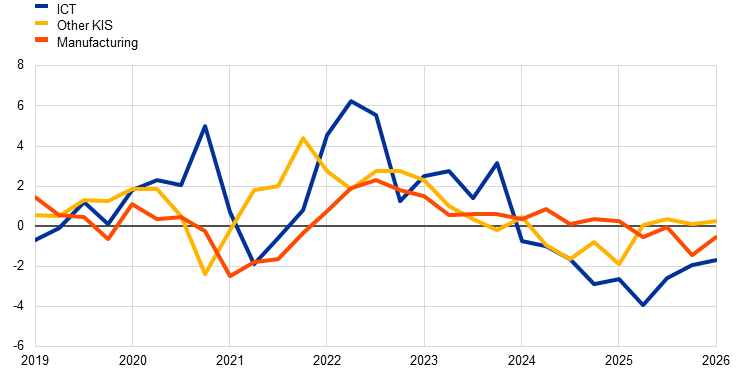
Sources: Eurostat and ECB staff calculations.
Notes: The latest observations are for the first quarter of 2026. 15-24 age group. Four-quarter moving average. “Other KIS” comprise financial services and professional services. Estimates are based on data for the period between the first quarter of 2008 and the first quarter of 2026. Residuals are from a dynamic Okun’s law relationship that relates the quarter-on-quarter growth rate in employment to the contemporaneous quarter-on-quarter growth rate in real Gross Value Added (GVA) by sector and to one lag each of employment growth and GVA growth.
Overall, the cooling of the euro area economy, and hence the labour market, has affected young workers. Accounting for real GDP developments, current job market prospects remain weak. At the same time, this weakness followed a period of unusually strong job creation and could in part be seen as a normal rebalancing (Arce and Sondermann, 2024; Berson et al., 2024). Existing evidence does not yet allow this pattern to be attributed to generative AI or remote work specifically. Several studies focused on the United States document evidence consistent with generative AI negatively affecting employment outcomes for young workers (Brynjolfsson et al., 2025; Dominski and Lee, 2025; Massenkoff and McCrory, 2026), while Lambert and Schindler (2026) instead attribute weaker early-career hiring to the rise of remote work rather than to generative AI. For the euro area, survey evidence shows that young and highly educated workers tend to hold mostly positive views about the impact of AI on their job prospects, and firms that invest in AI report higher employment growth (Dias da Silva and Weissler, 2025; Lebastard and Sondermann, 2026). Additionally, during the period 2011-19, characterised by advances in deep learning before the emergence of generative AI, employment shares increased in occupations that were more exposed to AI, particularly in those with a relatively higher proportion of younger workers and skilled workers (Albanesi et al., 2025). Continued monitoring of these developments is warranted as generative AI matures and its effects on the labour market become clearer.
References
Albanesi, S., Dias da Silva, A., Jimeno, J.F., Lamo, A. and Wabitsch, A. (2025), “New technologies and jobs in Europe”, Economic Policy, Vol. 40, No 121, January, pp. 71-139.
Arce, Ó. and Sondermann, D. (2024), “Low for long? Reasons for the recent decline in productivity”, The ECB Blog, ECB, Frankfurt am Main, 6 May.
Berson, C., Botelho, V., Dias da Silva, A., Foroni, C., Mohr, M., Schroeder, C. and Weissler, M. (2024), “Explaining the resilience of the euro area labour market between 2022 and 2024”, Economic Bulletin, ECB, Issue 8.
Brynjolfsson, E., Chandar, B. and Chen, R. (2025), “Canaries in the Coal Mine? Six Facts about the Recent Employment Effects of Artificial Intelligence”, Stanford Digital Economy Lab, November.
Dias da Silva, A. and Weissler, M. (2025), “AI adoption and employment prospects”, The ECB Blog, ECB, Frankfurt am Main, 21 March.
Dominski, J. and Lee, Y.S. (2025), “Advancing AI Capabilities and Evolving Labor Outcomes”, arXiv, No 2507.08244.
European Central Bank (ECB) (2021), “Employment and the conduct of monetary policy in the euro area”, Occasional Paper Series, No 275, September.
Lambert, P.J. and Schindler, Y. (2026), “The Broken Ladder: AI, Remote Work, and Early-Career Hiring”, SSRN Working Paper, May.
Lebastard, L. and Sondermann, D. (2026), “Artificial Intelligence: friend or foe for hiring in Europe today?”, The ECB Blog, ECB, Frankfurt am Main, 4 March.
Massenkoff, M. and McCrory, P. (2026), “Labor market impacts of AI: A new measure and early evidence”, Anthropic, Washington D.C., 5 March.
Legal Disclaimer:
EIN Presswire provides this news content "as is" without warranty of any kind. We do not accept any responsibility or liability for the accuracy, content, images, videos, licenses, completeness, legality, or reliability of the information contained in this article. If you have any complaints or copyright issues related to this article, kindly contact the author above.
